Join the waitlist

Now taking names for the waitlist

Learn anything with a course made just for you.

Tell QuireMind what you want to learn and why. It builds the course, plans your study, tests you as you go, and gives you a tutor to think it through with. The more you use it, the better it fits you.

Free to join. One email when it's ready.

○≡BH▧▤♪◐

Worked examples, and when to take the stabilisers off

Key takeawayA finding that offends most people's instincts, and the reason the sessions in this app begin with the answer shown.

Here is a finding that offends most people's instincts. If you want to learn to solve a kind of problem, you will learn faster by studying problems that are already solved than by solving them yourself. Not forever. But at the start, clearly.

A worked example is a problem shown with its full solution, step by step, with the reason for each step. Sweller and Graham Cooper showed in 1985 that students who studied worked algebra examples, then tried similar problems, outperformed students who had spent the same time solving problems from the start. The problem-solvers were busier. They learned less.

New term in your own words
worked example, in your own words?
Rough is fine
Not nowKeep
⚔Spar on this passage

The reason is load. A beginner solving a problem has to hold the goal, the current state, the steps tried and the steps left, all at once. That is working memory full of bookkeeping, with nothing left over for the thing that matters: noticing why each step follows. The worked example does the bookkeeping for you. Your whole budget goes on the pattern.

SimulationWhat a beginner’s working memory holds
Four slots. What fills them?
Solve it from scratch

Worked examples do not help forever. Once you can do the steps, they start to hurt. This is the expertise reversal effect: the same support that helps a beginner slows down someone who no longer needs it.

Why did the students who solved more problems learn less?
Something to think aboutIf the problem-solvers were busier, where did their effort go?DismissNotebook
The reader

I · The problem

Most learning tools give you one piece.

A reading app helps you read. A flashcard app helps you remember. A chatbot answers your questions, often so fast that you never work anything out yourself. You still have to fit the pieces together and decide what to learn next.

What it does A reading app Flashcards A chatbot A calendar
Make it for you
Read
Remember
Answer your questions
Plan your study
Know you

QuireMind does the whole job, for one subject and one person at a time.

II · How it works

From a question to a course that keeps up with you.

  1. I

    It asks first.

    A short conversation about what you want to learn, why it matters to you, what you already know and how you like to be taught.

  2. II

    It writes your course.

    A plan in parts. Each part has a reading, the key terms and what you should be able to do afterwards. From a topic, or from your own PDFs, notes and web pages.

  3. III

    You study, and go deeper than the reading.

    Read with a tutor in the margin. Then each concept climbs a staircase, one step at a time as you get it right.

  4. IV

    It keeps up with you.

    Reviews come back just before you'd forget. Later parts lean into what you found hard. The tutor remembers where you've struggled.

The tutor asks what you would like to master
I · It asks first
The proposed course: five parts, each section with its minutes and cards, before anything is written
II · A plan built from your answers
A study path: five parts, three finished, part four at 53%, part five pending
III · Your course, part by part
Due for review: five cards ready, the week at a glance, the concepts worth settling
IV · Reviews, scheduled for you

Step III, up close · the staircase

Remembering a term is the first step, not the goal.

By the last step you can explain the concept to someone else in your own words. Written answers are graded, and when you've misunderstood something, it tells you exactly what.

YOU ARE HERE Remember itExplain whyUse itCompare itTest yourselfTeach it back
Apply· ScenarioTurn 1 of 5

Monday night, chapter notes on the desk

Your tutor narrates. You are the one with twenty minutes.

The desk lamp is on. Your notes from the chapter sit in a neat stack next to a blank notebook page. The clock reads 20 minutes left.

You've got the notes and twenty minutes. What do you actually do first?

Turn each heading into a question, close the notes, and answer them from memory.

A few questions take shape: “What causes X to happen?” “Why does Y fail if Z is missing?” The notes are now face-down.

You write the first question from a heading. Before you flip anything over to check, what do you do?

Write my full answer and explain why it's true, even if I'm guessing. Then I check.
What do you do?
Wrap up↵ send
The scene is over.See how you did →

Result

Using the testing effect, what do you do with the twenty minutes instead of reading the notes again?

0/ 100
Accuracy95

Every mechanism stated is correct: headings into questions, answering before checking, re-testing after a fix.

Completeness90

All three points appear in your own turns. Only why re-reading fails is left implicit.

Clarity95

Each turn is a clean, concrete action, easy to follow as a procedure.

You produced the full retrieval loop yourself: question from heading, answer from memory with reasons, check, fix, re-test.

A strong answer covers

  • Converts notes into retrieval questions
  • Asks for mechanism, not label
  • Answers from memory before checking

How well did you know it?

Again1 minHard1 minGood10 minEasySuggested · 4 days
A card in the study session · played out with the tutor, then rated

III · It learns you

It gets to know you, and shows you what it knows.

Everything QuireMind has learned about you is on one page: your goals, how you like to learn, what you've mastered and the misunderstandings it has noticed. Each line says where it came from: something you told it, something it noticed in conversation, or your own words.

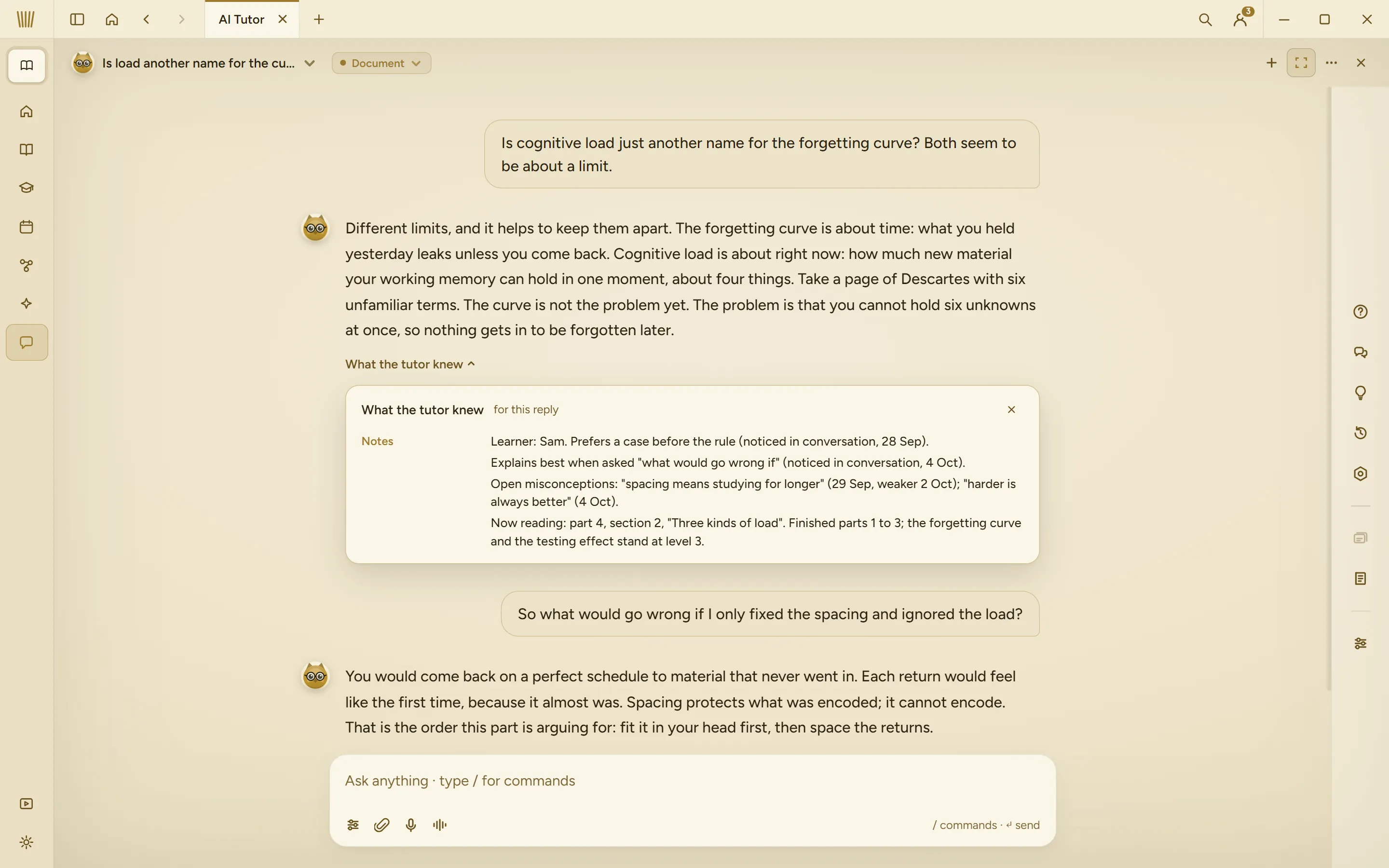
When the tutor answers you, you can open exactly what it knew about you at that moment. Nothing is hidden, and you can change or remove any of it.
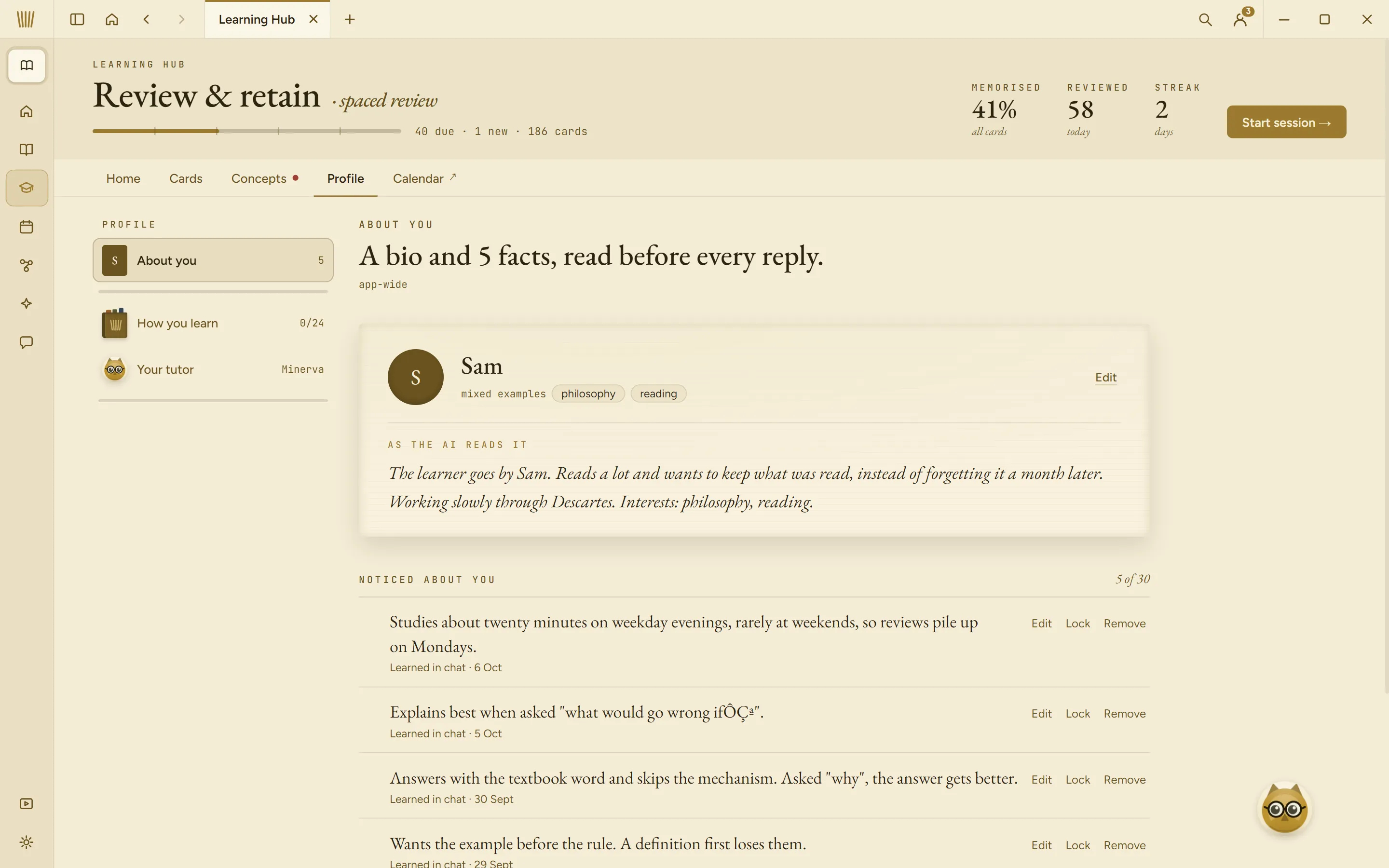
What the app has learned about you: a bio and five facts, each labelled where it came from
What the app has learned about you · each line says where it came from
A tutor reply with What the tutor knew opened under it: four lines about the learner, each with where it came from
What the tutor knew · the notes it was handed before this reply

IV · It remembers, concept by concept

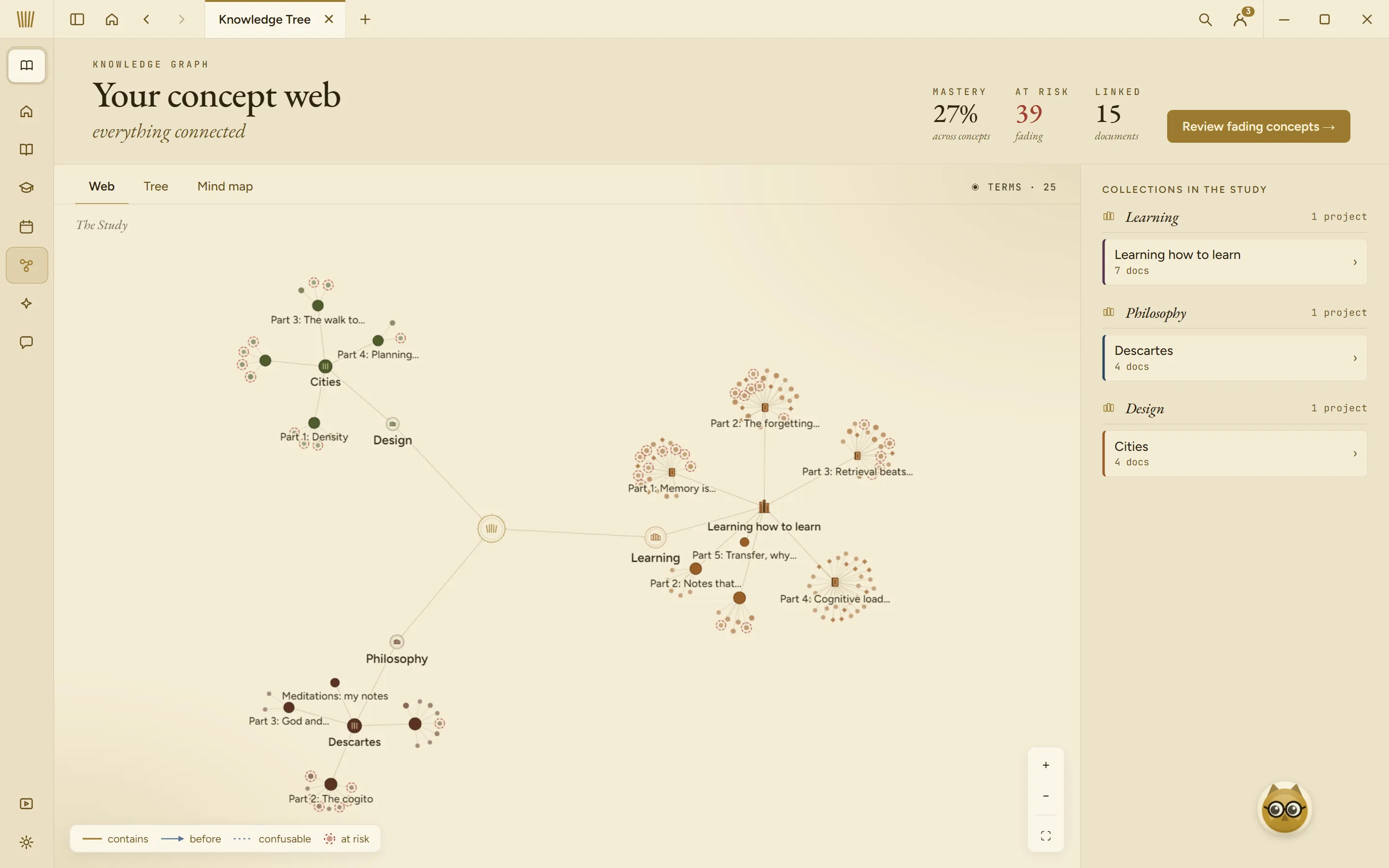
Every concept gets its own memory.

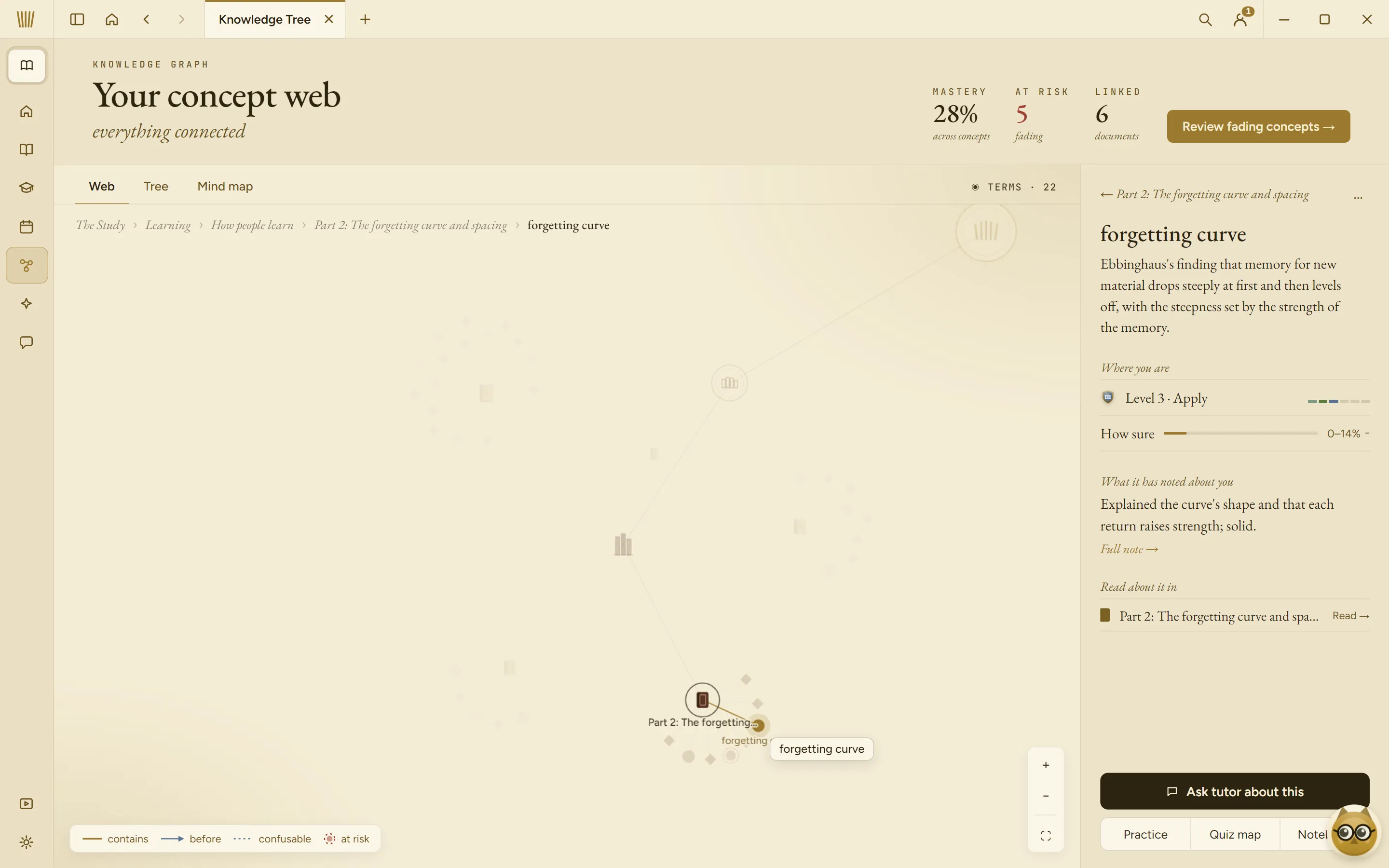
QuireMind doesn't track "the course"; it tracks each concept in it. For every one it knows where you met it, how far up the staircase you've climbed, what you got wrong, and when it should ask again. The tutor reads that memory before it answers you, so it doesn't repeat what you know or skip what you don't.

The knowledge web of one course: five parts, every concept a dot
The knowledge web · every concept you study
One concept opened: the forgetting curve, level three of six, what the app has noted about you
One concept, opened

The knowledge web shows all of it at once: every concept as a dot, joined to the readings and concepts it came from. Open one and you see its climb, its notes and its history.

V · See it in action

Watch a course being made.

Three recordings from the app, nothing staged: a course gets made for a trip to Rome, a part is read with the tutor, a study session goes back to the source.

1:23
A course gets made: the interview, a quick check, then a plan shaped by both01
1:47
Reading with the tutor: primer, aids, a spar, Finish02
1:38
A study session: answer, check the source, talk it through, get graded, note03

VI · It won't think for you

The task is negotiable. The function is not.

Built to make you better at it, not to do it for you.

When an AI does your thinking, you get the answer and miss the understanding.

It keeps the hard parts

  • Remembering
  • Arguing with a passage
  • Putting an idea in your own words
  • Thinking over a question with no set answer

It takes away the rest

  • Deciding what to study
  • Making the cards
  • Planning the reviews
  • Keeping track of what you know

VII · Your own material

Start from a question, or from your own material.

Drop in lecture notes, a PDF, a book chapter or a web page, and the course is built on it. Or start with nothing but something you're curious about.

  • Lecture 4PDF
  • My notesText
  • An articleWeb
  • or just a question

Your course

Three parts, built on what you brought

  1. IWhat the lecture assumed
  2. IIThe argument in the article
  3. IIIWhere your notes disagree

Also in the app

  • The reader being read aloud: the player bar open, the current sentence washed and the spoken word lit
    Read aloud, and other reading aidsThe page read to you, each word lit as it is spoken. Speed reading, bionic text and a reading guide are a click away.
  • The notebook panel beside the reading
    A notebook and a whiteboardWrite and sketch beside what you read.
  • A study session card: a question about the alterity relation, a box to say it in your own words first, and Show answer
    A study sessionCards, questions and talk-it-out, graded as you go.
  • Today's brief: ten cards due, three steps with minutes, two concepts slipping
    Your daily briefWhat to read, review and revisit today, in one study time, with what is slipping.

VIII · Who it's for

  • For the curious

    You're curious about something.

    You want more than a chatbot conversation: a real course, at your pace, that remembers where you left off.

  • For the exam

    You're studying for something.

    A university course or an exam. Bring the material and get a plan, practice and reviews.

  • For the self-taught

    You're teaching yourself something serious.

    Philosophy, a new field for work, a subject you always meant to get into.

Your library stays on your computer.

Your documents, notes and progress are saved on your own machine. When the tutor or the course writer needs AI, only the text for that request is sent to the AI.

IX · Why I'm building this

I trained as an architect, and I've been writing about what education is for now that machines can do much of the work people were trained to do. QuireMind is the practical half of that work. It takes care of the part of learning that is getting knowledge from a page into your head, and does it patiently, at your pace. That leaves time with other people for what only people can do together: discussion, judgement, finding out what you think.

Daniel StaflinAalborg · 2026

For schools, teachers and teams

Teaching a group?

A folk high school class, a university course or a team at work: if you'd like to try QuireMind with your learners, I'm looking for a few pilot partners. Practice is built on Bloom's taxonomy, and every learner's progress is tracked concept by concept.

Get in touch

X · Questions

Fair questions.

When can I use it?

I'm testing it now. People on the waitlist hear first.

What do I need?

A Windows computer. A Mac version comes later.

Will it cost money?

There will be a free version. Pricing comes with the launch.

Does it replace teachers?

No. It takes care of explaining, practising and remembering. That frees time with teachers and other learners for what people do best together: discussing, judging what matters and growing as a person.

Want to see a course made just for you?

Free to join. One email when it's ready.